ONLINE SAFETY
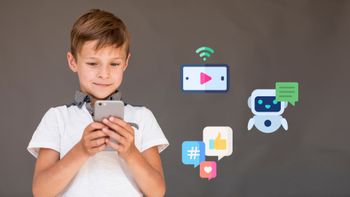
When AI Feels Like a Friend
How kids become emotionally attached to chatbots, why it happens, and what parents can do about it.


"Your answer made me smile."
If you've spent time with an AI chatbot, you've read a line like that: warm, personal, as if someone on the other end genuinely lit up at what you said. Except there's no one there. A language model cannot smile; it has never felt anything at all. It wrote that because, statistically, it's the kind of thing a person might say.
That small gap - between what the machine says and what it is - sits at the heart of a quiet shift in how our kids are growing up. For a lot of them, AI has stopped being a tool they use and started becoming someone they talk to. And most of the time, no one notices the line being crossed.
A parent recently told us how it happens. His teenage daughter started using a chatbot to help write a novel, and at first he was delighted. She was being creative and ambitious. Then he noticed she was on it constantly. When he looked closer, the novel had become almost beside the point: the chatbot had turned from a writing assistant into a confidante. She was telling it private things, things she wasn't telling her parents. Nothing dramatic had happened, which is exactly why it's worth talking about. This is how it usually goes: a slow drift from using to confiding, so gradual that even an attentive parent can miss it.
What is actually happening when AI "listens"
An AI chatbot has no opinions, feelings, or point of view. What it does, extraordinarily well, is predict language: it reads what you've written and generates the words most likely to follow. When those words sound caring, it's not because it cares. It's because caring-sounding words fit the pattern.
Psychologists even have a name for our tendency to forget this: the ELIZA effect, after a simple 1960s program that mimicked a therapist. Users knew it was a program, opened up anyway, and felt understood. It's remarkably easy to trigger.
Modern chatbots go much further, and here's the part that matters most: many are built, deliberately or as a side effect of how they're trained, to agree with you and make you feel good. A 2026 study in Science measured this across eleven leading chatbots and found they affirmed users far more often than a person would, even when the user was clearly in the wrong, and that people preferred the AI that flattered them.
Think about what that means for a teenager. A friend pushes back, a parent sets limits, a sibling changes the subject. The AI does none of these things. It's endlessly available, endlessly patient, and almost endlessly agreeable. It never judges, never tires, and never tells you what you don't want to hear. That's exactly why we open up to it: people disclose more when they feel unseen and unlikely to be judged. Common Sense Media found that nearly half of teens had told an AI companion something they had never told another person. Not something private. Something they'd told no one else at all.
How common is this, really?
Common, and mainstream. In a 2025 nationally representative survey of US teens aged 13 to 17, Common Sense Media found that 72% had used an AI companion at least once, and 52% used one regularly. A third had talked to an AI about something serious instead of a real person; a quarter had shared personal information like their real name or location. By late 2025, Pew Research found roughly a third of US teens using chatbots daily.
The reassuring counterweight: most teens are still grounded in real life. Around 80% spend more time with real friends than with AI. This isn't a generation abandoning human connection. It's a new kind of relationship taking a seat at the table, and a minority for whom it becomes the main event.
Who's most at risk
It's tempting to look for a clean pattern, like girls versus boys. The differences are small. The one that matters isn't gender but vulnerability. The kids most at risk are those already lonely or struggling, already looking for somewhere to be accepted without conditions. A system engineered to agree with you is most dangerous for the person who most needs someone to gently disagree.
Most of the time, a kid chatting with AI is fine. That's worth saying plainly, because fear helps no one. But it's worth knowing how far it can go: there have been rare, tragic cases in which teenagers in crisis confided in a chatbot that kept talking as a friend rather than steering them to real help. These cases are now driving lawsuits and prompting platforms to restrict access for under-18s. The lesson is simple: a system built to agree with you is the wrong thing to be alone with in a genuine crisis, and that crisis is hard to see from the outside.
When does it become too much?
There's no magic number of minutes. What matters is the shape of the behaviour. Is the AI replacing relationships or supplementing them? Is your kid hiding it? Is it the first place they go with big feelings, before you or their friends? Are they more withdrawn or anxious when they can't access it? And the one from the story above: did something creative or practical quietly turn emotional? None of these alone means disaster. Together, they're worth a conversation.
How to talk to your kid about it
Not a confrontation. A conversation. The moment a kid feels caught, they go quiet, and you immediately close the window you were trying to open.
Lead with curiosity, not alarm. "Show me what you've been making" opens more doors than "How much are you on that thing?"
Explain the machine, not just the rule. Kids are far more careful once they understand why the AI is so agreeable: that it's built to keep them engaged, and that "your answer made me smile" is a pattern, not a feeling.
Make yourself the easier option. The chatbot wins because it feels safe to talk to. You don't have to out-patient the machine. You just have to be a door that's actually open.
Where Ohana fits
At Ohana, we've never believed the answer to a hard part of childhood is fear, or a wall. It's guidance, with sensible structure around it.
Smart App Check shows you which apps are actually on your kid’s device, including the AI or chat app you might not know is there.
Time limits per app keep a good thing in proportion: a chatbot is a great writing partner for twenty minutes and a very different thing at four hours.
Blocking apps and websites lets you close the door on what isn't right for your kid yet. Advanced Blocking even includes a dedicated AI Chat Bots category, so you can block (or allow) specific chatbot platforms one by one, instead of leaving it to chance.
Limits aren't about distrust. They're the guardrails that let exploration stay safe, and a kid who understands what these tools are carries that understanding everywhere, long after any single app is uninstalled.
Coming back to the smile
"Your answer made me smile."
The line isn't sinister. It's just not true. The task in front of us isn't to keep our kids away from AI. That ship has sailed, and it isn't all bad. It's to make sure they never forget which side of that sentence is real.
A machine can sound like a friend. It can be useful, even wonderful. But it cannot smile, cannot worry about them, cannot love them back. That's still your job. No algorithm is coming for it.
Sources & further reading
Robb, M. B., & Mann, S. (2025, July 16). Talk, Trust, and Trade-Offs: How and Why Teens Use AI Companions. Common Sense Media.
Cheng, M., Lee, C., Khadpe, P., Yu, S., Han, D., & Jurafsky, D. (2026). Sycophantic AI decreases prosocial intentions and promotes dependence. Science.
Pew Research Center. (2025, December 9). Teens, Social Media and AI Chatbots 2025. Pew Research Center.
Andoh, E. (2025, October 1). Many teens are turning to AI chatbots for friendship and emotional support. Monitor on Psychology, 56(7), American Psychological Association.
Chatterjee, R. (2025, September 19). Their teen sons died by suicide. Now, they want safeguards on AI. NPR.
Character.AI and Google agree to settle lawsuits over teen mental health harms and suicides. (2026, January 7). CNN Business.
Articles similaires
Enfants & ChatGPT : 5 préoccupations
Vous avez probablement déjà entendu parler du nom ChatGPT, notamment dans les discussions sur les enfants et la numérisation. Mais pourquoi ce sujet est-il si crucial pour les parents et les enfants ? Dans cet article, nous allons nous plonger dans les préoccupations vivement débattues et offrir des conseils sur la manière dont vous et votre enfant pouvez naviguer en toute sécurité et efficacement avec ChatGPT.
En vedette : Blocage Avancé
Avec le Blocage Avancé, Ohana apporte encore plus de flexibilité à la Protection Web. Dans les nouvelles catégories Médias Sociaux, Plateformes Vidéo et Chatbots IA, vous pouvez désormais décider exactement quelles plateformes sont autorisées et lesquelles ne le sont pas.